

FR. WILFREDO MANALO SAMSON, SJ
“The best journey in life is returning home.”
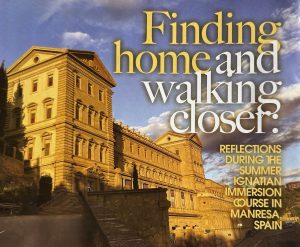
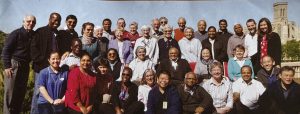
I felt richly blessed to be part of the summer Ignatian Immersion Course in Manresa, Spain. Thirty-five people Jesuits, religious sisters, and lay partners from all over the world came together for the course. On our first week of reflecting on the autobiography and spiritual diaries of Ignatius, and visiting places where God patiently taught Ignatius the ethics of discernment, purification of heart and submission of will to the Father, I felt I was on my personal inner journey of coming home. Like the prodigal son, Ignatius up to the age of twenty-six had given himself to the follies o Thirty f the world, vainglory, and selfish desires. But after his cannonball experience in Pamplona, he came to his senses and started his inner journey towards the love of God. The words of his aunt were fulfilled, “You will not learn nor become wise until someone breaks your legs.”
On his way to recovery, while reading the books “Imitation of Christ” and “The Lives of the Saints,” Ignatius thought of imitating the saints and going to Jerusalem. But after a while, he concluded that going to the Holy Land was not in God’s plan. His inner journey of seeking the will of God— his home, was not an easy path to take. Most of the time, he found himself “tired of examining what would be the best to do and not arriving at a definite conclusion.” (Autobiography (4), 16) In the end, he concluded that submitting oneself to God was the only path to enlightenment and illumination.
Reading Ignatius’ autobiography and spiritual diaries, I see myself in his inner struggles and journey from self-centeredness to otherness, from chaos to order, from darkness to light, and from holding on to total surrender. His intense desire to know concretely where and how to serve his Lord and Master led him to countless physical, emotional, and spiritual bouts.
At that time, there was at Manresa, a woman of great age, so much known for her long record as a servant of God in many parts of Spain, that the Catholic King had once summoned her. One day, this woman, speaking to the new soldier of Christ, said to him,
‘”May my Lord Jesus Christ deign to appear to you some day.”
“But he was startled at this, taking the matter quite literally, ‘How would Jesus Christ appear to me?’ He persevered steadily in his usual confession and communion each Sunday.” (A2T)
Finally, God granted his prayer in La Storta through a vision, “One day…he was at prayer in a church and EXPERIENCED SUCH A CHANGE IN HIS SOUL and SAW CLEARLY that God the Father PLACED HIM WITH CHRIST HIS SON that he would not dare doubt it— that God the Father had placed him with his Son.” (496) Indeed, when someone finds himself or herself beside Christ, our Lord, we are finally home. To be united in God, in heart, mind, and soul is to be at home. For God is our everything, and God is in everything.
We walked the path where Ignatius stayed, prayed, begged, and lived. And as we traced his journey in Montserrat, Manresa, Loyola, Javier, and Barcelona, we found ourselves entering into his inner world.
Ignatius made me aware of the same journey of finding my home in God. Where is the will of God in the here and now? As I humbly listen to God more and less to myself, I found myself one step closer to the Father. In the Gospel of John, Philip said to Jesus, “Lord, show us the Father and that will be enough for us.” (John 14:8 As I continue to reflect on the life of Ignatius in his struggles, fertile tensions, discernment of spirits, enlightenment, and surrender, I find myself at peace, consoled and affirmed that I am on the right path in my new ministry with the poorest of the poor in Kalookan. I am at home. The will of God is my home.
As a pilgrim, there’s no certainty of what’s ahead of me. Like Saint Ignatius, I simply submit myself to God’s mysterious ways. It’s not easy. Thus, I beg for the gift of discernment and wisdom to know His will and the audacity to fulfill it with joy.
Our interior pilgrimage and grasping for enlightenment will always be part of our lives. The will of God is active, moving, and mysterious. We may have lots of wonderful plans for ourselves and our ministries, but God is inviting us to be more open to His movements.
Let God disturb us. Let Him bring in our hearts the seeds of transformation and illumination: those creative fertile tensions that we daily encounter in our lives. Let that fire from the Holy Spirit ignite our hearts to take a bold step towards God’s enterprise. To find the will of God is to find our HOME.
Republished with the permission of the author, THE Windhover THE PHILIPPINE JESUIT MAGAZINE, OCTOBER 2019.