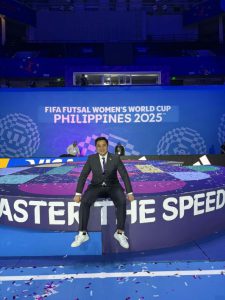
MICHAEL KEVIN GOCO
In 2017, I carried a dream that felt simple, almost naïve. I hoped that one day women’s futsal would have its own World Cup, and that Filipina girls—playing in public school gyms, dusty barangay courts, and Palaro meets—would one day experience what it meant to compete on the world stage.
I remember watching girls between thirteen and seventeen years old play with instinct, courage, and joy. Their talent was raw, but their desire was clear. I remember thinking that they deserved more than obscurity. They deserved a platform, and they deserved to be seen.
When I took up the FIFA Master in 2020, women’s futsal became an advocacy I carried with me everywhere. I spoke about it whenever I could, to classmates, colleagues, and friends. I spoke about the Philippines, about girls in Negros, Iloilo, and Cebu playing a game that few paid attention to, but one that mattered deeply to them. Together with others who believed, we pushed the idea forward, refined it, defended it, and insisted that this story mattered. If we did not tell it, no one else would.
In 2023, FIFA announced the creation of the Women’s Futsal World Cup. For the first time, there was a sense that something might be possible. I allowed myself to think that perhaps the Philippines could one day be part of it. I never imagined we would host it.
In 2024, the PFF, under the leadership of President John Gutierrez, submitted what we knew was an ambitious bid. We were competing against countries with stronger futsal traditions, deeper resources, and more experience. In the Philippines, most people did not even know what futsal was. Basketball and volleyball dominated public attention, and even football struggled for space. Funding across sports was limited, and unlike others, we did not have years to prepare.
(‘FUTSAL is a fast-paced version of football (soccer) played indoors on a smaller, hard court with five players per team. The name comes from the Portuguese/Spanish phrase for “indoor football”.’)
When the announcement came, it was difficult to fully understand what had happened. FIFA said yes to the Philippines. Looking back now, I know it was not simply luck. God opened a door that none of us could have forced open on our own.
Hosting the first-ever FIFA Women’s Futsal World Cup became the most challenging period of my professional and personal life. We started with very little. There was no local experience in organizing a FIFA tournament, no financial safety net, and a federation already balancing many commitments. What we had was belief, a sense of responsibility, and a leadership team willing to carry the weight.
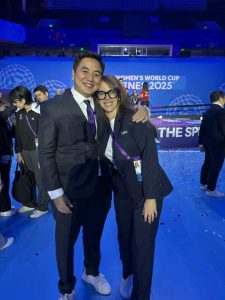
There were many moments of frustration. There were days when quitting felt like the most reasonable option. Colleagues left, not because they lacked commitment, but because the pressure became too heavy. There were long stretches when the path forward was unclear and when even people within football questioned whether we should continue.
It was during these moments that God worked on me quietly. When I felt frustrated, He taught me patience. When hope felt thin, He taught me to continue with faith rather than certainty. When relationships became strained and disagreements grew difficult, He reminded me to respond with kindness and restraint.
This World Cup brought me closer to God in ways I did not expect. I became more prayerful, not because I wanted control over outcomes, but because I slowly learned that control was never mine to begin with. I learned to let go, to do the work placed in front of me, and to trust that God would take care of what I could not.
There were many nights when prayer was the only thing that carried me through the next day. Over time, small problems were solved, one by one. Progress was slow, but it was real. Momentum built quietly, and eventually, what once felt impossible became manageable.
Standing inside a sold-out PhilSports Arena for the final between Brazil and Portugal, I felt a deep sense of gratitude to God. It was His work, and His will.
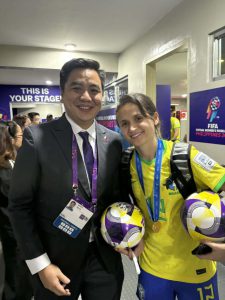
I listened as Filipino fans reacted to the rhythm of the game, to the transitions, the tactics, and the intensity. I heard people say they finally understood futsal. That moment alone justified every difficult day that came before it.
Together with the PFF, FIFA, the PSC, the LOC, our volunteers, staff, and partners, we delivered something historic. The first-ever FIFA Women’s Futsal World Cup was held on Philippine soil. It will be remembered, not because it was perfect, but because it happened where many believed it could not.
I hope Filipinos now see what futsal advocates have always known. The game is fast, intelligent, and creative. It suits our people. More importantly, it opens doors. It creates opportunities, scholarships, and safer spaces for young girls who simply want a chance.
This tournament may be the only FIFA World Cup our country hosts for a very long time. That reality does not diminish its value. It makes it more meaningful.
We did this with limited resources, with many doubts, and with faith. God carried us through moments we could not have endured on our own.
To break glass ceilings, there is always a cost. But faith teaches us that the cost is never wasted.
Maraming salamat, Pilipinas. (Thank you very much, Philippines.)
Maraming salamat, PFF.
Maraming salamat, FFWWC 2025 LOC.
Maraming salamat, FIFA.
Above all, thank You, Lord.
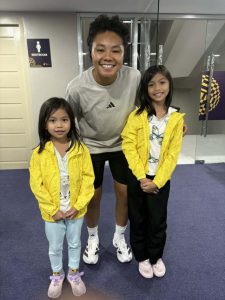
To my family, especially my wife, who carried far more than her share while I was often absent in body and mind, thank you for your sacrifice. To my children, especially my daughters and my son playing futsal on a dusty court in Iloilo, this dream belongs to you.
This dream is ours. This is God’s will.
When I look back on this journey, I realize that God plants seeds—quiet ambitions and seemingly personal goals—long before we understand their true purpose. We often take the first step believing we are doing something for ourselves, for our careers, for our communities, or for our country. Only later do we come to understand that these moments were never about achievement. They were God’s way of drawing us closer to Him, teaching us trust, humility, and faith along the way.