
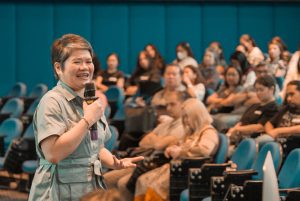

MARGARITA “MAITA” M. LADRIDO, PH.D
I have been an educator and a school administrator for more than twenty years. Before that, I spent almost a decade as a full-time mission worker for Youth for Christ. These two worlds— mission and education—have shaped my deepest conviction: young people have the power to change the world, and God delights in working through them.
I have seen firsthand what happens when a young person encounters Jesus—truly encounters Him, not just through theory or doctrine, but in a living, personal way. When a young heart discovers that God is real, loving, and close, something extraordinary happens. I have watched countless young people fall in love with Christ, experience His mercy, and rise transformed.
They do wonderful things. They serve generously. They lead boldly. They go the extra mile. They inspire others toward a deeper relationship with God. They choose paths not only of ministry, but of medicine, law, business, arts, teaching, technology, and public service—bringing Christ with them wherever they go. Their lives are not perfect. They struggle like all of us do. They make mistakes, stumble, fall, and sometimes get lost. But what moves me most is this: they return to the Lord. They rise again, grow stronger, and continue their journey with faith that is more mature and resilient.
It is a sight to behold. And it is a privilege that has shaped the way I view Catholic education today.
Because of these experiences, I believe with all my heart that Catholic education must offer young people something deeper than memorized doctrine or moral lessons. These things matter, but they are not enough. In a world full of noise, pressure, distraction, and emotional struggle, children need not only information about God—they need an encounter with Him. They need to know God as a loving Father who sees them, a companion who walks with them, a source of peace when they are anxious, a safe refuge when they feel overwhelmed, and a friend who never leaves. Faith cannot simply be taught. It must be witnessed, experienced, and lived.
Today’s young people are keenly discerning. They do not respond to long lectures or rigid instruction, but to authenticity, respect, warmth, and genuine listening. They are highly mindful of equality and acceptance, and their passionate advocacy for inclusion inspires me deeply. This spirit of welcome is profoundly Christ-like—it echoes Jesus calling the marginalized to His dinner table. If Jesus loves all, so must we. Therefore, our greatest lesson cannot be taught from a textbook; it must be lived out by the adults who surround them. It is not enough to talk about kindness and mercy; parents, teachers, and administrators must demonstrate these values in their every action and word. We must approach them with deep respect for who they are—their personalities, questions, struggles, and dreams. Faith must be an invitation, not an imposition. Our role is to create spaces where children can slowly and freely grow into a relationship with Jesus at their own pace, modeled by a community that practices what it preaches.
Over the years, I have learned that the most powerful tool in Catholic education is not a program, a lesson plan, or a textbook. It is the heart of the teacher. When teachers build their own relationship with Jesus, draw strength from prayer, turn to God during challenges, and witness openly to what God is doing in their lives—children see faith alive. A teacher who says, “Prayer helped me through this difficulty,” or “God gave me peace when I felt overwhelmed,” or “This is how Jesus has guided my life,” touches young hearts in ways that sermons never could. This vulnerability helps students remember that everyone makes mistakes, and everyone needs God. Children are inspired by authenticity. Pope Francis reminds us that faith spreads through “attraction.” A teacher who loves God makes students want to know Him too.
As an educator, I spent a lot of time learning—about theory and improving my practice to engage students in the classroom. I am not a Theology professor, but I believe in my heart that it doesn’t really matter what subject I teach, the mission remains the same: how can I bring my students to know love and serve Jesus Christ. There is a thirst in the youth today. They want to know Jesus and have a relationship with Him. We just need to listen and find ways for this to happen. Last year I witnessed for the first time, one of my students convert to Catholicism. I’m sure it wasn’t because of me—it was because she met Jesus in school and shared that she wanted to learn more about being Catholic. The year before, we had a college student who asked us how she could receive the Holy Eucharist. She was baptized but she never had the opportunity to have a First Holy Communion. This year, we have nine college students who expressed that they wanted to receive the Sacrament of Confirmation. As a College, we have to make this happen because this is our mission, this is why we exist!

Modern life brings challenges that young people carry quietly—anxiety, loneliness, depression, pressure to perform, overstimulation, the constant noise of social media. Children often feel unsure of who they are and where they belong. This is why Catholic education must be a place where children can breathe, pray, be listened to, reflect, feel safe, and recognize God’s presence in their daily lives. Here, prayer is not a requirement—it becomes a source of comfort, clarity, and hope. Pope Francis’ Fratelli Tutti reminds us of the importance of relationships, community, and solidarity. Ex Corde Ecclesiae urges Catholic institutions to form the whole person. The Global Compact on Education calls us to build environments where young people feel supported and accompanied. Catholic education must respond to all these.
My years with the youth—on mission areas, in classrooms, and in school communities—have taught me one powerful truth: when a young person meets Jesus, everything changes. This is why Catholic education matters. This is why we must protect it, strengthen it, and reimagine it. This is why I continue to give my life to this mission. Young people today are searching—for identity, belonging, truth, and purpose. Catholic education has the sacred task of showing them that all these can be found in God. Our schools must be places where children can encounter Jesus, experience His love, grow gradually in faith, discover their mission, fall and rise again, and ultimately become the people God created them to be. This is not only possible—I have seen it with my own eyes, again and again. And it remains the greatest joy and privilege of my vocation.

*Margarita is currently College Dean of Assumption College, San Lorenzo Village, Makati, Metro Manila.
WOW WOW.
Words are not enough to convey my feelings of my being proud of my niece Maita!